© Madeline Bocaro
An excerpt from
In Your Mind – The Infinite Universe of Yoko Ono
https://linktr.ee/conceptualbooks

Coming Soon:
Listen… The Musical Universe of Yoko Ono
by Madeline Bocaro
Season of Glass – Released June 8, 1981 UK / June 12, 1981 USA
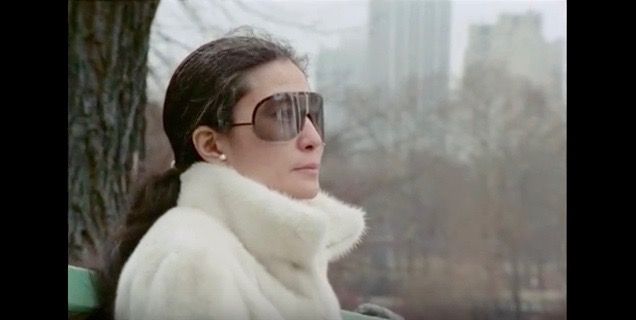
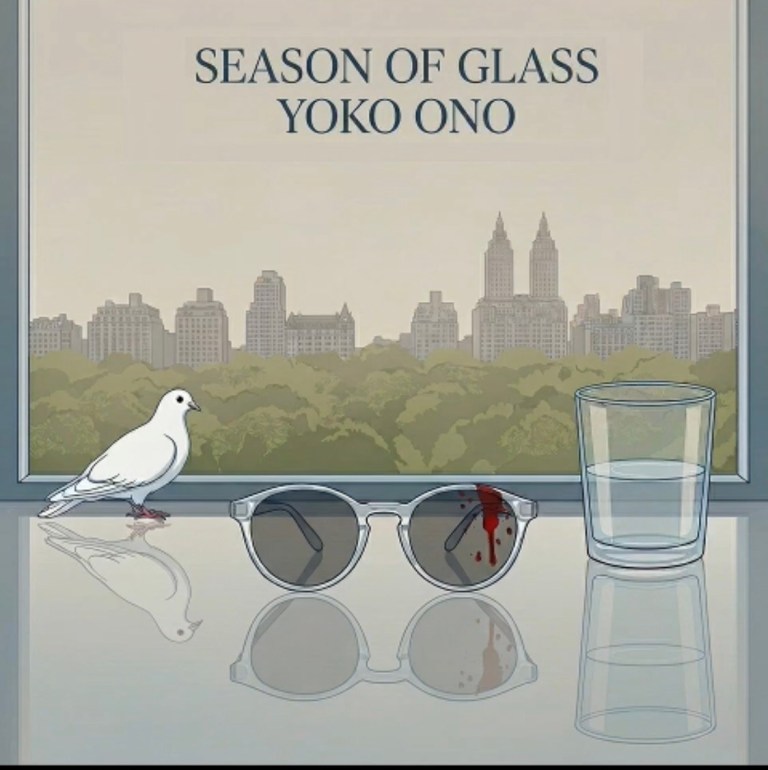
A glass half empty. Her dead husband’s eyeglasses smeared with his blood. The window, the camera lens. All glass. Transparent. A misty rainy-day photograph reflecting and refracting the New York City skyline through several gloomy horizons. A view from their bedroom window above Central Park. Their home. The city that John loved.
This was Yoko’s fragile world in December 1980.

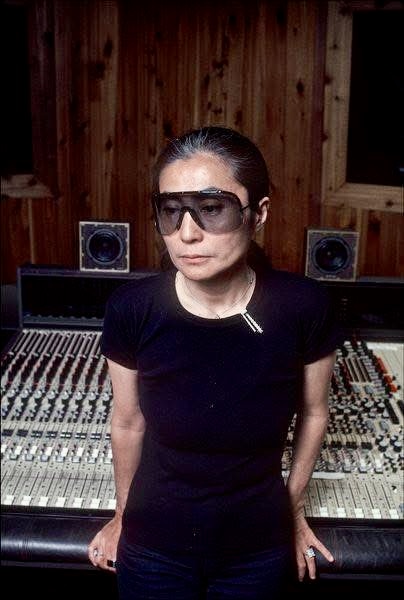
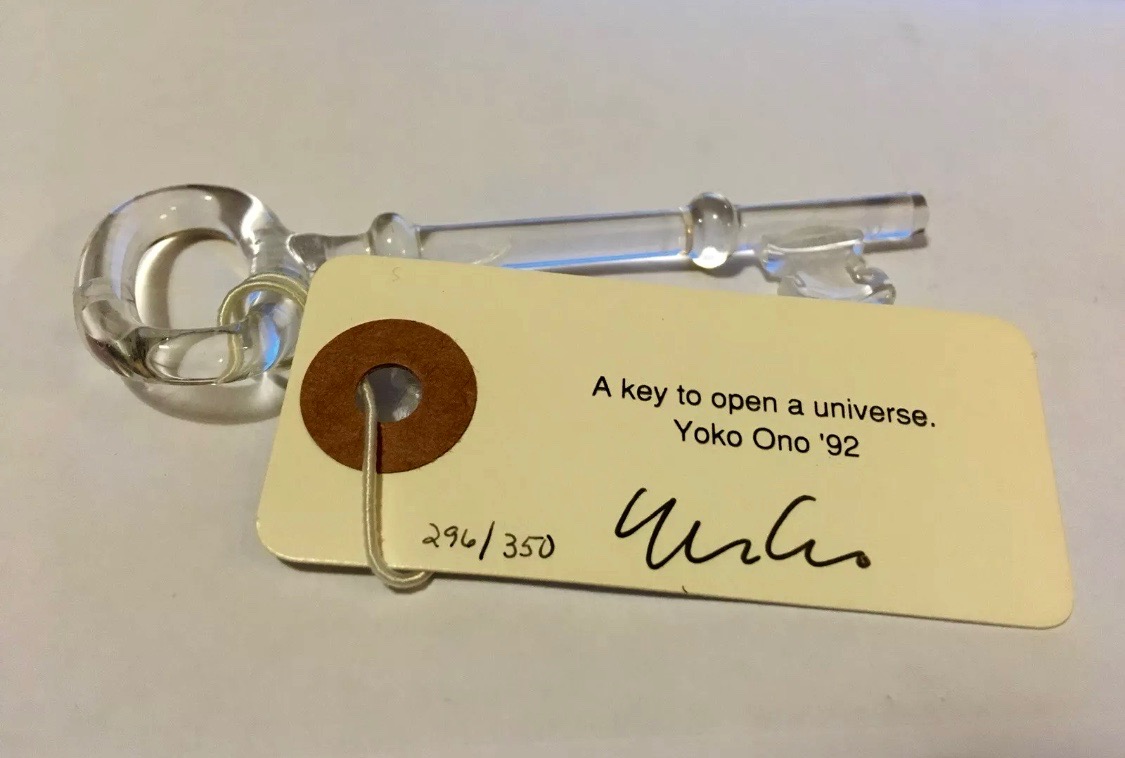
In the early days, glass was a clear portal to the Yoko’s world. Her Painting to Let the Evening Light Go Through consisted of a transparent pane for letting in light. Her glass keys opened the sky. Her glass hammer could not break anything without breaking itself. But in December 1980, glass became Yoko’s only protection. She began to wear dark shades (John had recently selected them for her) hiding her eyes – a barrier between her and the world. Yoko would spend decades behind glass.
We were all broken after the unthinkable tragedy that occurred on December 8, 1980. The world was in mourning days later at John’s vigil on a cold sunny afternoon, suddenly turning gray when a cloud covered the sun. A delicate snow began to fall during the silence – as if on cue. As the vigil ended, the cloud passed and it was sunny again. When spring appeared in June 1981, the sun was shining, yet the bitter chill and darkness remained. “The season that never passes.” It never would.
The first release from Yoko in January 1981, less than a month after John’s death – was ‘Walking on Thin Ice’. It is not included on Season of Glass, but it was the song that she and John were working on in December 1980 during the Double Fantasy sessions. John absolutely loved Yoko’s song. The night before he was murdered, John played it repeatedly – all night long – predicting that it would be Yoko’s first No. 1 hit. In fact, a clip of him saying this is included at the start of the song in the Onobox collection (1992). Yoko was shocked when John’s prediction came true in 2003 , when a CD of ‘Walking on Thin Ice’ remixes became Yoko’s 11th No. 1 single on Billboard’s Hot Dance Club Play chart. It hit No. 1 again in 2013.
On the groundbreaking original version, John Lennon and Earl Slick play scathing guitar lines to this unnerving, brittle song about the fragility of life, risk, repercussion and death. The chilling lyrics suddenly became a shocking and sad reality. John was carrying the tape of ‘Walking on Thin Ice’ when he was murdered. Yoko’s vocals on the track eventually inspired countless artists in many genres.
Yoko’s solo album Season of Glass followed six months later in June 1981 – in another season, summer. She tried to heal after John’s death by going right back to work, making music and finishing the songs they had started together. Although Yoko was still extremely fragile, she seemed unbroken. She became the ‘glass lady’ in the Double Fantasy song ‘I’m Moving On’.
“Glass lady is a surreal, symbolic “other” in anybody’s life.”
– Twitter Q&A 2017
On the album cover, Yoko shares her nightmare – illustrating what the world had done to John, and to her. Yoko reflects the horror right back on society, just as Jacqueline Kennedy wore her blood-stained Chanel suit in public for the remainder of the tragic day that she experienced the exact same trauma – seeing her husband killed in front of her. Yoko lets us see through the shattered window of her world and hides nothing – as always.
When they met, John and Yoko instantly and intimately bonded. They faced the world together – naked. Thirteen years later, Yoko was suddenly alone. She sticks by her decision to keep the cover artwork despite the label’s protest and request to change it.
“John was killed, and it was very important for me to show that to the world, and for people to remember. Because I think that all of us are responsible of his death, of course including myself and both John and I were always trying to make a peaceful world. And it’s very ironical that John who loved peace so much, died in a violent way.”
– Yoko, Ina France television interview December 1981
https://www.youtube.com/watch?v=5wC_pQB-ZD8
“Yoko needed to share the reality of what she saw – John lying on the cement ground in front of their home.”
“…I’ve seen a floor with a pond of blood. And that was the reality. And this was like a very, very, mild expression of that. And I was totally amazed that people felt that I was exploiting him. It wasn’t that at all. I felt the oneness with him and we were saying, `Please look at me. This is what you did to me.’ I mean, that’s what John wanted to say, I think.”
– To Jody Denberg, Ono Oh Yes! Reissuing Yoko, The Austin Chronicle June 27, 1997
First, Yoko premiered a music video created for ‘Goodbye Sadness’ featuring beautiful, yet heartbreaking footage of herself and John together. Yoko recites the following poem (on the album’s back cover) in this video version of the opening song, broadcast only once on Saturday Night Live just after John’s passing. The last lines encapsulate her sadness and fragility.
spring passes and one remembers one’s innocence
summer passes
and one remembers one’s exuberance
autumn passes
and one remembers one’s reverence
winter passes
and one remembers one’s perseverance
there is a season that never passes
and that is the season of glass
‘Goodbye Sadness’
Season of Glass is a work of beauty, sadness and healing. It is sometimes emotionally trying, but we become enveloped in its delicate aural mist. Phil Spector was initially a discreet co-producer, but Yoko took over in the final stages of recording at The Hit Factory in NYC. Her vocals are sometimes childlike – quivering and frail with steadfast sincerity and brutal honesty. At other times her voice is strong, full of anger and fear.
She said in the Season of Glass liner notes in 1981,”
“My voice kept cracking while I recorded the songs. I finally thought maybe I shouldn’t put the album out. Then it occurred to me there were probably many people in the world whose voices were cracking for many reasons. I realized my songs were the songs of the desperate. It was all right to show myself as how I was.”
The opening song, ‘Goodbye Sadness’ was written when John and Yoko were separated in 1974. John was struggling without Yoko in Los Angeles. She told Goldmine in November 1997,
“…People were calling me and saying, “You have to come and take care of him because we can’t deal with him… and on my way back from L.A,. I was in a plane by myself and I was just intensely writing ‘Goodbye Sadness’ just like I wrote ‘It’s Alright’ later…”
The ‘Goodbye Sadness’ video begins with the same four jolting gunshots (representing what happened to John) followed by Yoko’s scream which opens the song, ‘No No No’. The album version starts only with Michael Brecker’s woeful sax intro. Yoko’s fragile voice is like a prayer – purging fear and sadness, and welcoming happiness.
Goodbye, sadness Goodbye, goodbye I don’t need you anymore
I wet my pillow every night / But now I saw the light
Goodbye, goodbye, sadness / I don’t need you anymore
Goodbye, goodbye, sadness / I can’t take it anymore..

The melancholy ‘Mindweaver’ takes place on the telephone. It’s a guitar and vocal duet. Her idea was to create a song with the dignity of a Spanish mourning song. It’s a flashback to the constant phone calls she having with John about reconciling in 1974. The phone conversations they were having from New York and Bermuda in 1980 reminded her of that time.”
The enchanting, magical and comforting lullaby ‘Silver Horse’ is sung by Yoko in a small, high pitched voice in childlike wonderment. It exists somewhere between a prayer and a dream. In the first two verses Yoko resists false hope when she encounters new vistas; ‘a house I’ve never seen before ‘/ ‘a stream that’s running gently’. They stir up repressed traumatic memories that instill feelings of trepidation.
Yoko finds hope in an imagined silver horse, then realizes that he doesn’t have wings, and cannot whisk her away. She resigns herself by being positive, ‘No wings? Well, it wasn’t so bad you know’ (an uplifting line, which John loved when he heard it during the Double Fantasy sessions) and resumes her life as it was. In the last lines, Yoko identifies as a wandering soul (Furaibo 風来坊 – ‘a person who comes like a wind.’)
Yoko: ““I am a Furaibo (meaning “wanderer”) in my head… I understand that New York is my home, but I don’t have such feeling for it that much… In short, it is extremely scary when I recognize that I am a root-less human being. Therefore, it might be better to have a belief that this is my root. But my life did not turn out to be like that. Up to this point. I don’t know about it from now on.”
– KAZE ROCK, Japan – March 2010
Most of the songs on Season of Glass are re-workings of older ones. ‘Will You Touch Me’ was written in 1971. Others are from 1973: ‘Turn of the Wheel,’ ‘Toy Boat.’
‘TOYBOAT’ is another desperate lullaby. Drowning in desperation, Yoko is asking for help from a bigger unnamed power, “You who are…” to help her out of the purgatory of sadness she now resides in. Everything she sees is a deception. The lake she dreams of is a picture lake. The castle is full of flies. The toy boat is an illusion of perspective in her mind. The boat that she hopes will rescue her looks small from far away, yet it remains small when it comes closer and reaches the shore. Another illusion of salvation, like the silver horse with no wings.
In the Onobox liner notes, Yoko explains,
In TOYBOAT I hear my voice sounding strange, like a person
drowning. I used a photo I took of John’s blood-stained glasses
on the record cover. The record company called me and said the
record shops would not stock the record unless I changed the
cover. I didn‘t understand it. Why? They said it was in bad taste.
I felt like a person soaked in blood coming into a living room full
of people and reporting that my husband was dead, his body was
taken away, and the pair of glasses were the only thing I had
managed to salvage – and people looking at me saying it was in
bad taste to show the glasses to them. “I’m not changing the
cover. This is what John is now,” I said.
‘Even When You’r e Far Away’ was written in 1973 during the separation from John, when they were in the phase of reconciliation. Yoko told radio host Jim Ladd that John played her a cassette of his new song ‘Bless You’ when he visited her.’ She offered to play her song for him, but he declined (saying it would be “too painful.”) She now realizes that John never heard this song. It now has young Sean Lennon’s spoken intro about a bedtime story that his father used to tell him. Yoko saw that in the universal scheme of things, John’s passing is “just a little story.”
‘Nobody Sees Me Like You Do’ was written in 1973. John had told Yoko that he liked the chords on this one during the Double Fantasy sessions.
Yoko told American Songwriter in 1992,
“John liked the chord sequence. It’s probably pretty prevalent in country music but you don’t use that much in rock.”
Released 18 months after John’s death on Season of Glass, this became his wife’s song of eternal love, apology and longing. The most poignant lines indicate the foretelling loneliness that Yoko felt before the tragedy that took John from her, and from us all.
Even with your warmth and closeness
This feeling of loneliness hangs over like a curse / thirst
Before meeting each other in 1966, John and Yoko had separate, lonely, extraordinary and sometimes tragic lives. They deeply understood and saved each other. Ultimately, fame was suffocating and tore them apart. But their eternal love always brought them back to each other. In a comment in one of his last interviews, John pictured himself and Yoko on the coast of Ireland in rocking chairs, thumbing through their ‘scrapbook of madness’. This is reflected in Yoko’s lyrics;
I wanna see us together again
Rocking away in our walnut chairs
On the remix CD Yes, I’m A Witch Too (February 2007) there is a beautiful reverberating remix of ‘Nobody Sees Me Like You Do’ featuring The Apples In Stereo. The track begins with Yoko asking for a ginger tea. The gorgeous arrangement includes chimes and a lovely synth solo.
‘Dogtown’ was written in 1972 when John and Yoko lived in their Bank Street apartment in New York City. It was to appear on her album A Story. She had Gogol’s book Diary of a Madman in mind, as she told David Garland, Spinning on Air WNYC Radio, May 13, 2012…
“The front room was three steps down to the door. When you look outside from the window, you can only see people’s legs walking. I just remembered Gogol’s Diary of a Madman. Each time you read you get choked up. It’s a beautiful story. I was Gogol just sort of creating it…”
Gogol’s book is written in diary format, recording the protagonist’s gradual slide into insanity. In his madness, he begins to comprehend a conversation between two dogs. He reads letters that the dogs have written to each other. He also loses his sense of time.
At dawn in ‘Dogtown’ while the city is still asleep, Yoko invokes animism, imagining herself as the embodiment of things in nature – a stone with emotions, a tree with a history. Perhaps referring to all of her “unfinished” work, the lyrics speak of unfinished business, and wanting to be remembered for all the things she did not do, including untold stories. She is again dealing with negative space. She would like to be remembered for,
A warm smile I meant to leave
And a true song I meant to finish writing all my life
Yoko also told David Garland in 2012 on his radio show,
“In the end I’m saying something about one day I want to create the best song or something, and I’m thinking, I’m still that woman who’s trying to sort of strive for something. It still chokes me up because I know that that’s what I want to do, and I still have never done it yet.”
Unfinished art and music are a long-recurring theme in all of Yoko’s work. She also invokes an old nursery rhyme with a twist on the words; Peas porridge luck, peas porridge stuck…
‘She Gets Down on Her Knees’ was also part of the unreleased album, A Story in 1974. It was first released as an acoustic bonus track by Rykodisc in 1997. On Season of Glass there is an added bridge. The song had been a bit funkier with a classical jazz intro. It was also remixed for Yes, I’m a Witch, Too in 2016.
There are several recorded versions of ‘She Gets Down on Her Knees’. The first is on A Story featuring a jazzy intro followed by one full minute of frenetic strings – reminiscent of Bernard Herrmann’s Psycho film score. A Yoko only piano/voice demo was recorded in 1974. The song appears on Onobox (1992) with a foreboding steamship horn intro. On Season of Glass (1981) it also has the steamship horn at the start, and includes a bridge: “Blue patches in the clouded sky / Too high to catch her tears and sighs / Looking over tenderly…” The song was also re-mixed for the 2016 Yes, I’m a Witch Too CD.
‘Extension 33’ (A demo version appears on Onobox). was also left over from Yoko’s solo album Feeling The Space (1974) which was meant to be a double set called Half a Windsong.
Some songs on Season of Glass were recorded with John in the 1970s and were released as bonus tracks on other Ono reissues, such as the acoustic version of ‘Dogtown..
Yoko’s then unreleased 1974 album A Story also contained several songs later re-recorded for Season of Glass; ‘She Gets Down On Her Knees’ and ‘Will You Touch Me’. A Story was released on Rykodisc in 1997. (Some of the songs were previously included in Onobox, 1992).
‘Mother of the Universe’ is a prayer for the universe, written in 1978. ‘
‘Silver Horse,’ ‘Goodbye Sadness’ and ‘Mindweaver’ (originally titled ‘Mind Fucker”) were copyrighted in 1980. The 1981 compositions were the bone chilling ‘I Don’t Know Why’ (demoed on December 9th) and ‘No No No’ which could only have come to be at this time. It was written two nights after John was murdered.
Yoko explained the evolution of ‘I Don’t Know Why’…
“…a song that came to my mind about two nights after John was shot. I was in bed trying to close my ears to the sound of John’s records being played loudly outside the Dakota building by fans, especially ‘Imagine’. Then the song came into my mind. I was in such a state I couldn’t think of the chords. It hadn’t occurred to me to go to the piano that was in the room. I picked up a cassette tape recorder that was always next to our bed and recorded the song acappella. I did not change one word when I recorded it later. At the time I envisioned the end part as half an hour of screaming and swearing. But in the studio, I decided not to do it that way.”
In the lyrics, Yoko lashes out (for perhaps the only time in her life) at the unimaginable hatred that she and John endured over the years simply for being together.
You bastards!
Hate us! hate me! we had everything…
(The acapella demo of ‘I Don’t Know Why’ which Yoko recorded alone just after John’s death was included on the 1997 Rykodisc reissue of Season of Glass).
Other Ryko reissues featured acoustic bonus tracks of early songs; ‘Will You Touch Me’ and an acoustic ‘Dogtown’). ‘Will You touch Me’ was commissioned by a Japanese singer, and this was Yoko’s guide vocal for her.
There is a discomforting video for the discordant ‘No, No, No’ in which beautiful Yoko faces a mirror, having an oral fixation – obviously feeling emptiness, loss and ambivalence about sexual situations as a widow. The lines about unfulfilled promises refer to pacts that John had made but cannot fulfill as he is no longer here. The melody and outro are played by a real ambulance siren and the gunshots are real. Yoko wrote about the song in the 1992 Onobox liner notes…
‘NO, NO, NO’ was written and sung by a woman who was in such a pain that her heart was cracking while she kept her mind clear so she could survive for herself and for her son. Of course that was me – right after John passed away. When John was still alive, he kept whispering to Sean that he will always be there for Sean and protect him. So when John left, Sean kept saying “Promise is made to be broken.” Making it light than what it was. He was in pain. Sean loved this song. Each time when I sung “I don’t remember what you promeeesed” and elongated the end of it, he used to let his body go down at the same time to the floor. I remember how hard it was for me to go through that period, especially, knowing how Sean was managing to hide his tears.
“NO, NO, NO was how I felt through the first couple of months. John was dead. I was alive. But John’s side of the bed was still warm when I came back from the hospital. My side was cold. I was shivering. It was as if John were still alive. I wanted somebody to hold me. In my mind, I was saying please, hold me. I wanted to stop shivering. I was saying please, don’t hold me. My body still remembered my husband’s warmth. My mind was like a shattered glass, the sharp points split in tangents. I made myself impossible for anybody to hold me. When I wrote the song, I juxtaposed the atonal and minor chords… In the recording, I used real gun shots and sirens. It was not a tea party. A musician came to me and said he could make a siren effect with the guitar, using two of my atonal chords. “It’s better to keep the song a musical experience,” he said. He played the chords. I didn’t like it. It was too beautiful. It lacked the urgency I was feeling. No, it had to be the real siren. I knew what “Musique Concrete. But I hadn’t been taught such an option in my composition classes.”
‘No, No, No’ – watch:
https://www.youtube.com/watch?v=wepbHqMKn0M
Sean Ono Lennon told Rolling Stone’s David Fricke on June 11, 1998,
“I remember Season of Glass, the music moving me so much.
It’s an amazing accomplishment that she went into the studio after my dad died.
She takes the most painful, most intense experiences and turns it them into beautiful art. And I think that’s what my dad loved so much about her.”
Yoko spoke more about the album cover, which she designed and photographed herself.
” To have those glasses on the cover was important because it was a statement and you have to understand that it was like John wanted you guys to see those glasses. Because that was what was done to him. I saw what was done to him. It was worse than that cover shows. I’ve seen the worst of it and that cover was just like a very mild statement, s little message to you from John.”
– Yoko to Tom Hibbert – Q Magazine 1988
Yoko asked photographer David Nutter (who had taken the wedding photos of John & Yoko in Gibraltar) for technical advice on how to shoot the album cover. She believes that the still water in the half-empty glass appears to be sad, reflecting Masaru Emoto’s experiments and studies on the emotions and memory of water.
On the back cover is the Season of Glass poem, typewritten in the same open window, pictured on the front cover. John’s bloody glasses on the table are replaced by a live plant. The glass is now full. A dark silhouette of Yoko is entering the picture from the right side. Yoko maintains that a glass is always, in actuality 100 percent full: 50% with water and 50% with air.
ONOBOX – Rykodisc 1992
DISC 5: NO, NO, NO
(Liner notes by Yoko – excerpt)
This disc is made of excerpts from Season Of Glass, It‘s Alright and Starpeace. The three albums I have recorded since John’s death.
There is a story about a composer who went to his mother’s funeral and though he was very upset about the loss, he could not help noticing that his sister was crying off key. It was a story to indicate how inhuman a composer can get in his professionalism.
Listening back to these tracks, I don’t know how I made them at the time when I was in sheer pain. But I also think it helped me to get through the hard times to just think about being on key.
NO, NO, NO was how I felt through the first couple of months. John was dead. I was alive. But John’s side of the bed was still warm when I came back from the hospital. My side was cold. I was shivering. It was as if John were still alive. I wanted somebody to hold me. In my mind, I was saying please, hold me. I wanted to stop shivering. I was saying please, don’t hold me. My body still remembered my husband’s warmth. My mind was like a shattered glass, the sharp points split in tangents. I made myself impossible for anybody to hold me. When I wrote the song, I juxtaposed the atonal and minor chords. Which suited the woman who felt like she was wearing a pair of mismatched shoes. In the recording, I used real gun shots and sirens. It was not a tea party.

***
This story is ann excerpt from the ultimateYoko Ono biography:
In Your Mind – The Infinite Universe of Yoko Ono
Hard cover books exclusively at:
Follow:
https://linktr.ee/conceptualbooks
Coming Soon:
Listen… The Musical Universe of Yoko Ono
by Madeline Bocaro
Listen to Yoko’s Season of Glass poem:
Now in the Rock & Roll Hall of Fame Library & Archives
On several Best Books lists
Praised by Ono’s colleagues
Acclaimed by MOJO & Goldmine
Recommended by Olivia Harrison
Honorable Mention in The Beatles Gift Guide
Spotlighted on The Beatles Channel, Sirius XM Radio

© Madeline Bocaro 2019. No part of this text may be copied, photocopied, reproduced, translated or re-blogged in whole or in part. Reproduction without permission is prohibited. All text written by Madeline Bocaro is protected by United States copyright law and may not be copied, distributed, transmitted, displayed, published or broadcast without prior written permission.
madelinex.com is a non-profit blog created for educational and research purposes.
Any content that may violate copyright or free usage laws will be removed upon request.


What a great piece; thanks for taking the time and care.
Thank you very much Greg. Happy to share this with you.
I remember people putting her down for the cover,I thought it was brave and touching.Im going to pull it out and playing it.This was Yoko letting out her pain.I worked at a music store on that dreadful morning that I heard it.So sad ,my son was 2 and remembers me at back door,crying,
An important and underrated album. Great art from cover to last note. Certainly in my top ten, along with both John and Yoko Plastic Ono Band solo albums.
Thank you for this thorough, beautifully written analysis.