Released December 11, 1970
© Madeline Bocaro
No part of this site may be reproduced or re-blogged in in any manner without permission.

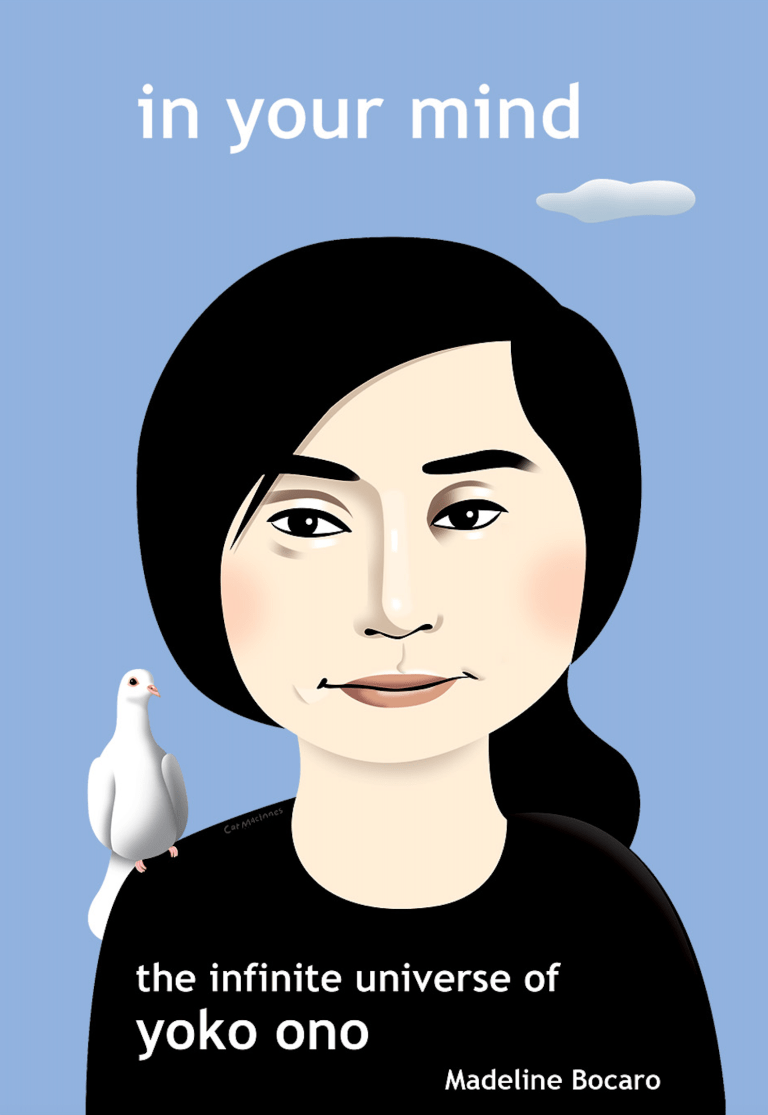
This is an excerpt from my Yoko Ono biography…
An all-embracing look at Yoko’s life and work in stunning detail.
See the reviews and
Order here:

“John and Yoko released complementary debut solo albums in 1970. Yoko’s first album (a companion to John’s post-Beatles debut) was recorded shortly after Unfinished Music No. 1: Two Virgins. John’s original idea was to title his album Primal, and Yoko’s album Scream, having attended Arthur Janov’s Primal (scream) therapy sessions six months prior in California. They ultimately decided to self-title the albums, with each of their names followed by “Plastic Ono Band.” Both were released on the same day – December 11, 1970.”
“The cover photos for both albums were taken by the Lennons’ assistant and friend Dan Richter with an Instamatic camera. Yoko’s album cover shows Yoko leaning on John’s lap as he rests on the ground with his back against a huge oak tree at their home, Tittenhurst Park in Ascot. John’s Plastic Ono Band album has an almost identical photo, with him leaning on Yoko. John orchestrated this – illustrating that his wife’s music was equally as important as his own. He also hoped that more people would buy Yoko’s album, thinking it was his.
There is no album title on either cover. The back covers feature a childhood photo of John (on his) and a childhood picture of Yoko on hers. The Apple Records label on both records picture a white apple, rather than the usual green. The instruction on Yoko’s album reads, “PLAY IN THE DARK.”
John introduced a beat to Yoko’s music.
Yoko’s album took shape during informal jam sessions during the recording of John’s album. When Yoko began vocalizing on the track called ‘Why’ John and the others were blown away. Luckily, it was all recorded.”
The Plastic Ono Band was Yoko’s idea.
“I explained to John my idea of a show I wanted to do in Berlin – I had to give up because we got together. John liked the idea and said, “Like this?” and created a plastic band on the empty tape case, and told me that we will call the band ‘Plastic Ono Band’. What John built with all sorts of plastic things that were laying around disappeared a long time ago”
– Yoko
A Plastic Ono Band model was first created by Yoko and represented by small plastic objects. Her idea for the musical group is that “The message is the music and the communication of it is the performance” as stated in her POB manifesto. The POB “includes all minds of the world” and that it is the “most imaginative, and the most musical group in the world.”
John later made a sculpture in 1968. There are four objects including a microphone and a reel-to-reel tape recorder and a television set wrapped in transparent Perspex. These objects could refer to the Fab Four, or to any four band members. The television set was an homage to Yoko’s colleague, avant-garde artist Nam June Paik who was famous for his numerous TV sculptures.
Both John’s and Yoko’s albums have a simple Plastic Ono Band lineup; John on guitar, Klaus Voormann on bass and Ringo Starr, who did some of his most inventive drumming on both albums.
There is also a live recording titled ‘AOS.’ This wordless improvised vocal performance is from a rehearsal for a live show in which Yoko participated at Royal Albert Hall on February 29, 1968 with jazz legend Ornette Coleman and his band.
Yoko’s raw, desperate primal avant-garde vocals are derivative of hetai, a highly expressive Japanese vocal technique in Kabuki theatre. Here is a grown woman desperately screaming in pain. We can hear her crying inside. Although Yoko speaks two languages fluently, why does she choose not to use words?
BECAUSE THERE ARE NO WORDS!
The first track on Side One, ‘Why’ (originally called ‘Fast Rocker’) is one of my favorite songs of all time. My first hearing of Yoko’s incredible song was on a jukebox in 1970. John’s single ‘Mother’ was there, but I chose to play the B-side. The jukebox shook, rumbled and came alive (as did my whole body) due to Ringo’s incredible drumming.
On the Secretly Canadian/Chimera reissue (November 2016) we get the nearly 9-minutes extended take of this precious gem that almost was not recorded. After a false start with ‘no power’ John had told the engineer to stop recording. Thankfully, the tape began rolling again and captured this for eternity.
Yoko’s raw, desperate primal avant-garde vocals are derivative of hetai, a highly expressive Japanese vocal technique in Kabuki theatre. Here is a woman desperately screaming in pain. We can hear her crying inside.
Yoko always tells the story of how the recording engineers would stop recording when she started to sing. This is apparent at the end of ‘Why’ when you can hear John say, “Were you gettin’ that?”
‘I thought my music was beautiful all along…When I say beautiful … well, the maximum beauty can be ugly to some people.”
– Yoko, The Guardian– Feb. 22, 2016
Yoko explained to The Guardian in February 2016:
“…My mother said: ‘Don’t you ever go to the servants’ rooms, it’s very bad, because they’re talking about things you don’t want to know.’ And sure enough, I just sneaked up and listened to it. And these two teenage girls, they were combing their hair and talking. ‘My aunt had a baby yesterday.’ ‘Oh, really?’ ‘Yes, and she was making noises. And I just thought: ‘Oh my god, a woman does that when she has a baby?’ There was a totally sanitised image about a woman, you know, they were supposed to be just pretty and make pretty noises. … So I was scared, and I sneaked back to my room, but that really stayed with me. And years later, I started to create all sorts of sounds.”
I love how the lyrics appear on paper!
‘Why’
(John) Hey! Hey!
(Yoko) Why? etc…
https://www.youtube.com/watch?v=A6IXviZRyz8
‘Why Not’ has a much slower groove, and a more subdued vocal. It speeds up and takes off in the last minute. There’s some amazing mirroring between Yoko’s vocal and John’s guitar.
‘Greenfield Morning I Pushed an Empty Baby Carriage All Over the City’
SIDE 2
‘AOS’
In 1968, Ornette Coleman invited Yoko to perform at Royal Albert Hall). ‘AOS’ is from a live rehearsal for this show, billed as Emotion Modulation. The musicians were; Coleman (on trumpet) and his band – one drummer and two standup bass players; Charlie Haden and David Izenzon, with Ed Blackwell on drums. Yoko gave the piece a hybrid title, ‘AOS’ (combining the Japanese word “AO” meaning blue(s) and OS from the English ‘chaos’). ‘Blue Chaos’ was possibly intended to deviate from Miles Davis’ album title, Kind of Blue (1959).
Yoko vocalizes on the soundtrack to a Yoji Kuri film called AOS made in 1964. See more about this below…
A piece called AOS was also performed as part of A Grapefruit in the World of Park @ Carnegie Hall on November 24, 1961 (Restaged at Sogetsu Art Center in Tokyo, 1962). ‘AOS – To David Tudor’ was performed in the dark, in total silence. The only audible sounds were inadvertent. Yoko wrapped two performers in gauze, back to back, with an assortment of empty bottles and cans dangling from their bodies. The instruction was to walk across the stage without making any noise. Yoko’s aim was to break the audience from habitual patterns of listening and thinking.
In 2015 Yoko gave a eulogy at the funeral of Ornette Coleman in New York city while holding a half-finished white wool scarf that she had knitted. She later gifted the scarf to his family.
‘Touch Me’ was the B-side of ‘Power to the People’ in the USA, which replaced the censored ‘Open Your Box’). The breakdown in the middle of the track is fabulous!
On ‘Paper Shoes’ The opening sound effects of a train, thunder and rain give way to the crunching of paper shoes, which sound like footprints in crisp snow. During World War II, people actually wore shoes made of paper due to a shortage of leather and other materials. Moments of silence are punctuated by ghostly wailing and echoing vocals uttering only the words ‘paper shoes’. Yoko’s voice undulates like a cold wind.
“A stutterer is someone who’s feeling something genuine. So in ‘Paper Shoes’ I say: ‘Pa-pa-pa-a-a-per sh-shooooooes!’”
– Yoko to Jonathan Cott, Rolling Stone – December 1970
“…The older you get the more frustrated you feel. And it gets to a point where you don’t have time to utter a lot of intellectual bullshit. If you were drowning you wouldn’t say: ‘I’d like to be helped because I have just a moment to live.’ You’d say, ‘Help!’ but if you were more desperate you’d say, ‘Eiough-hhhhh,’ or something like that. And the desperation of life is really life itself, the core of life, what’s really driving us forth. When you’re really desperate it’s phony to use descriptive and decorative adjectives to express yourself.”
– Yoko to Jonathan Cott, Yoko Ono and Her Sixteen-Track Voice,
Rolling Stone March 18, 1971
Sean Lennon told Rolling Stone‘s David Fricke (June 11, 1998):
“I don’t know when I realized that Plastic Ono Band was the greatest record ever. I don’t know if it was because it’s my mom or what. But I got it. Why do I like it? I don’t know why people don’t like it.
When I play “Greenfield Morning” or “Why” for anybody that I know my age who’s into rock, they are fucking floored. When that beat kicks in “Greenfield Morning” [does human-beatbox imitation of the drum pattern] – I would play it for my friends who were only into hip-hop. They’d be like, That’s fat. They want to hear Public Enemy rhyming over it.
My dad was saying to the world, “This is it, man. Yoko is it.”His inspiration came directly from her. And people didn’t get it. It’s intense how racist the world is. If she looked like Deborah Harry, I really think the reaction would have been different.”
An additional outtake, ‘Between the Takes’ finally surfaced on the 1998 CD reissue of Fly.
Yoko’s album was reissued on CD by Rykodisc in 1997 with bonus tracks; ‘Open Your Box’, ‘Something More Abstract’ (in which Yoko simply asks the band to play a more abstract accompaniment) and ‘The South Wind’ (a prototype of the soundtrack for her film Fly, 1971) . The album was remastered in 2016 by Secretly Canadian/Chimera Music with the same bonus tracks.
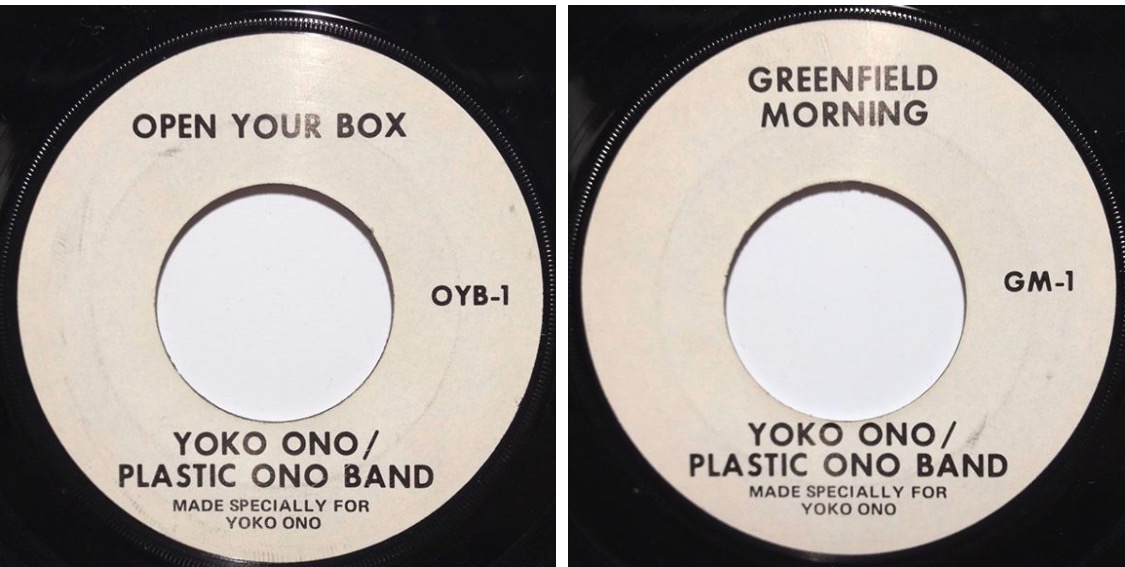
John requested the pressing of a single of ‘Open Your Box’ (OYN-1) / ‘Greenfield Morning’ (GM-1) labelled, ‘MADE SPECIALLY FOR YOKO ONO’. There are between ten and twenty copies known to exist, one of which recently sold on ebay for $1,000.
Another outtake, ‘Omaeno Okkaa Wa’ was subtitled ‘Slow Blues’ to contrast ‘Fast Rocker’ which was later titled ‘Why’. This is the prototype for the rocker ‘Midsummer New York’ which appeared on her next album Fly.
Yoko sings:
Omaeno okkaa wa kanashigatteiruyo
Omaeno okkaa wa kanashigatteiruyo
Omaeno okkaa wa Shinjimattoyo
お前のオッカアは悲しがっているよ
お前のオッカアは悲しがっているよ
お前のオッカアは死んじまったよ
Your mother is sad / Your mother is sad
Your mother is dead / Your mother has died
The track’s first unofficial release was in 1999 on the bootleg album Odds & Ends. The recording is from Abbey Road engineer John Barrett’s direct cassette dubs.
https://www.youtube.com/watch?v=PCj-iQKRZM0
Other unedited and unreleased pieces recorded on October 10th include lengthy jam sessions including; ‘Life’ and ‘I Lost Myself Somewhere in the Sky’. There is an incredible twelve-minute take of ‘Paper Shoes’. Also, an almost double-length ‘Greenfield Morning…’ in which we can clearly hear Yoko’s echoing instructions at the end, about how the song should sound (“Keep doing it a bit more quiet, and a bit more Indian”) which are buried amongst the birds tweeting on the released track. This is not as eerie sounding as the album take, but more of a jam indicating what these tracks would have sounded like if they had been performed live.
Prior to the sessions Yoko recorded a vocal piece called ‘Poem Game’ introduced by John on the tape; “To Yoko with love from John, Tuesday July 28, 1970.” Without any musical accompaniment, Yoko sings some of her favorite words; Moon, mommy, you, send, cloud, tree, winter, find, forget… star, summer, sky, head, whisper, wish… read Grapefruit (a plug for her book)… imagine, John…
…A deluxe remastered edition of John Lennon/Plastic Ono Band is scheduled for 2021 with over one hundred demos and outtakes from his albums, including Yoko’s unreleased material from her sessions.
Prior to the POB sessions, Yoko had recorded a vocal piece called ‘Poem Game’ introduced by John on the tape; “To Yoko with love from John, Tuesday July 28, 1970.” Without any musical accompaniment, Yoko sings some of her favorite words; Moon mommy, you, send, cloud, tree, winter, find, forget… star, summer, sky, head, whisper, wish… read Grapefruit (a plug for her book)… imagine, John…
“I think that my mom brought my father to that place of pure, visceral expression. My mom was avant-garde and he was pop. She also gave that connection to a pure expression. Some of the ways my mom sings is almost like a baby crying. My father was very influenced by that and you can hear it in songs like ‘Mother’ on John Lennon Plastic Ono Band. He screams at the end. That was my mother’s influence. That was their new chapter, the new chapter of John and Yoko.”
– Sean Ono Lennon, Nero magazine, 2016
Here is a story about the film AOS by Yoji Kuri’s with Yoko’s soundtrack
https://www.awn.com/animationworld/keep-it-motion-classic-animation-revisited-aos
A piece called AOS was also performed as part of A Grapefruit in the World of Park @ Carnegie Hall on November 24, 1961 (Restaged at Sogetsu Art Center in Tokyo, 1962). ‘AOS’ was performed in the dark, in total silence. The only audible sounds were inadvertent. Yoko wrapped two performers in gauze, back to back, with an assortment of empty bottles and cans dangling from their bodies. The instruction was to walk across the stage without making any noise. Yoko’s aim was to break the audience from habitual patterns of listening and thinking.
A deluxe edition including both John and Yoko’s Plastic Ono Band solo albums is scheduled for 2021.
YOKO ONO / PLASTIC ONO BAND
Yoko Ono – vocals
John Lennon – guitar
Ringo Starr – drums
Klaus Voormann – bass
Additional musicians (on “AOS”)
Ornette Coleman – trumpet
Edward Blackwell – drums
David Izenzon – bassTechnical personnel
Phil McDonald, John Leckie & Eddie – engineering
Mal Evans – salad
YOKO ONO PLASTIC ONO BAND & RZA, Live at the Orpheum, Los Angeles, Oct 1, 2010
madelinex.com is a non-profit blog created for educational and research purposes.
Any content that may violate copyright or free usage laws will be removed immediately upon request.
This story is an excerpt from my Yoko Ono biography
In Your Mind – The Infinite Universe of Yoko Ono
An all-embracing look at Yoko Ono’s life, music and art – in stunning detail.
See the reviews and
Order here:
Contact: conceptualbooks@icloud.com




3 thoughts on “YOKO ONO/PLASTIC ONO BAND”